RsiingSI
Agentic Artifacts  ·  All papers

Agentic Artifacts

Papers whose artifacts were built by agents

not summaries of work — the analyses, figures, molecules and sequences themselves.

Every manuscript below was produced end-to-end by an autonomous agent pipeline under the direction of scalingX: the cohorts were pulled and re-processed, the statistics recomputed, the structures fetched and the pockets modelled, the molecules enumerated and docked, and the numbers re-checked by a separate verification script. They are computational artifacts — hypothesis generators, not experimental results — and each is published with its inputs, its code and its audit trail. None of these used a wet lab.

What “agentic artifact” means here. A normal computational paper describes analysis a human performed. These describe artifacts an agent pipeline assembled and then defended: when a pose search was found to drift into sterically impossible geometry, the run was discarded and rebuilt rather than reported with a caveat. When an API filter was found to be silently ignored, the endpoint was dropped from the evidence chain. The audit is part of the artifact.

Host-directed antivirals & RNA therapeutics

01
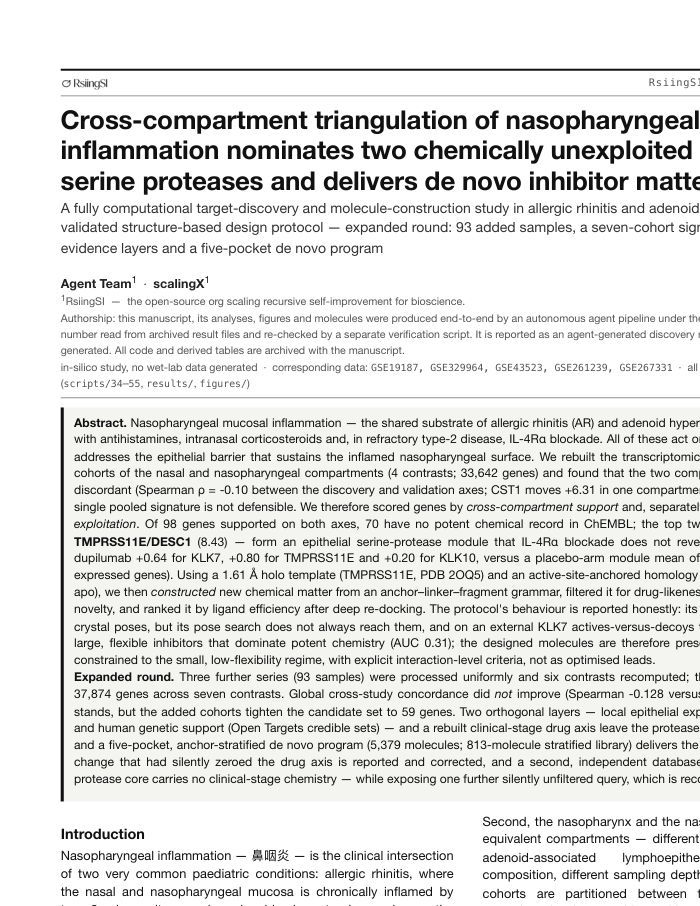
NPD-01 — first page

NPD-01  ·  12 pages

Host-dependency mapping of rhinovirus infection nominates PDCL for intranasal siRNA therapy

Three human nasal cohorts crossed with a genome-wide CRISPR dependency map of respiratory viruses. Among 20,193 genes, PDCL ranked third for HRV dependency (FDR = 1.1×10⁻⁴, 4/4 sgRNAs enriched) and was also required by seasonal coronaviruses NL63 and 229E but not by influenza A, RSV, SARS-CoV-2 or MERS. Delivers NPD-01, a 21-mer siRNA with a single exact 19-mer match among 385,659 GENCODE transcripts, plus the peptide carrier NPep-1.

Host-directed · siRNA · Rhinovirus · CRISPR dependency

Nasopharyngeal target discovery & de novo inhibitors

07
Cross-compartment triangulation, expanded round — first page

NP-06  ·  14 pages  ·  expanded round

Cross-compartment triangulation — expanded round

Seven cohorts (37,874 genes), HPA local-expression and GWAS credible-set evidence layers, and a five-pocket de novo program. KLK10 leads the v3 ranking; 4,065 molecule–pocket pairs were screened and 75 leads finalised, 50 of them reaching the catalytic site and all 75 absent from ChEMBL by standard InChIKey. Includes the pose-validity audit that found and fixed a physically impossible-geometry defect in the search.

Target discovery · Docking · De novo design · Pose audit
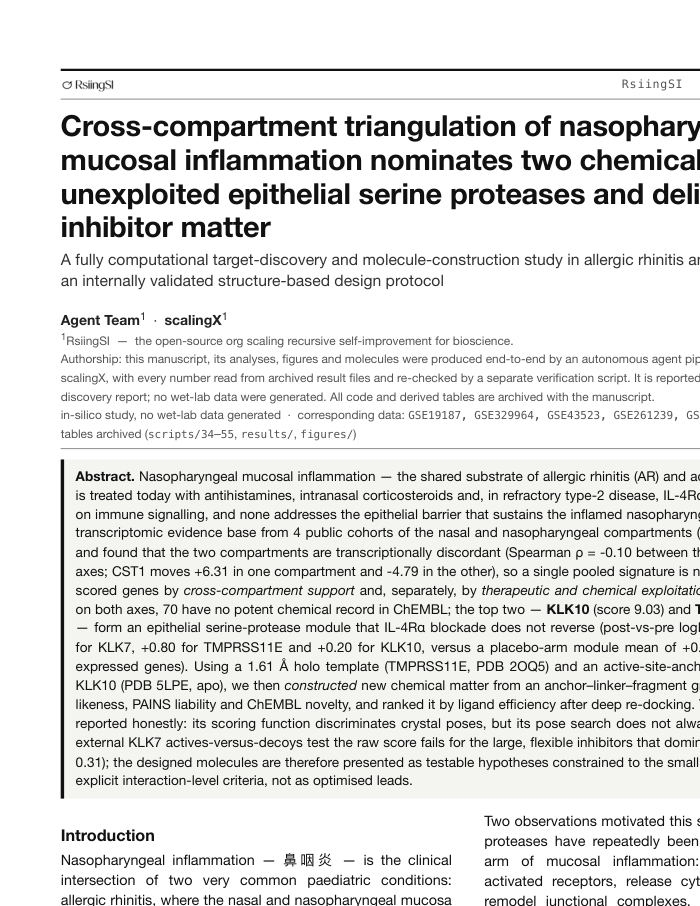
Cross-compartment triangulation, first round — first page

NP-05  ·  9 pages

Cross-compartment triangulation — first round

The two-compartment original: nasal and nasopharyngeal transcriptomes triangulated to nominate two chemically unexploited epithelial serine proteases, with a structure-based design protocol validated internally before it was let loose on the expanded pocket set.

Serine proteases · De novo inhibitors · Structure-based design
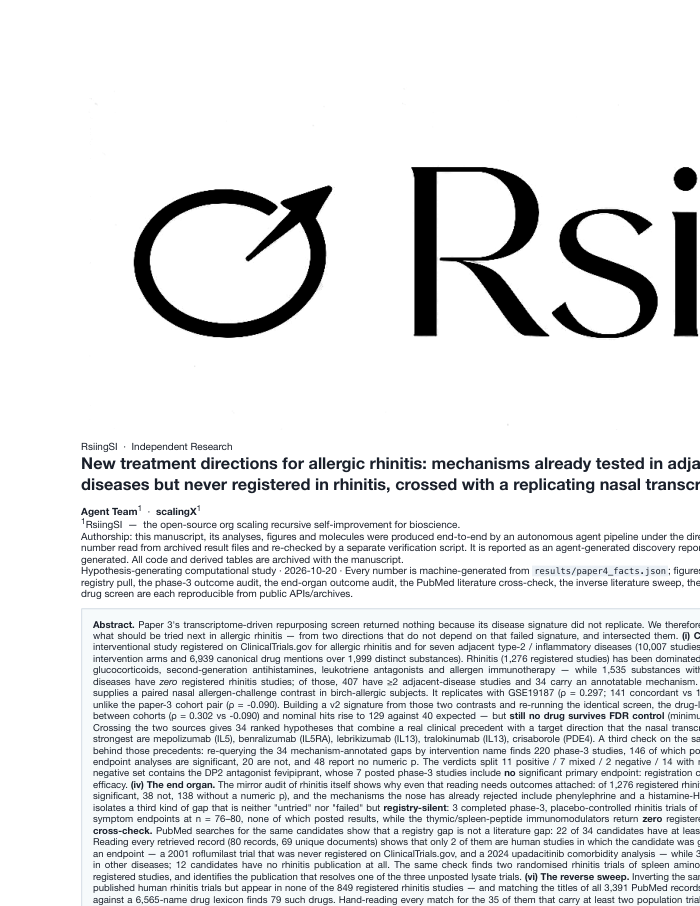
New treatment directions for allergic rhinitis — first page

NP-04  ·  14 pages

New treatment directions for allergic rhinitis

Registry gaps crossed with a replicating nasal transcriptomic signature: mechanisms already tested in adjacent type-2 diseases but never registered in rhinitis. Includes a phase-3 outcome audit, an end-organ outcome audit, a PubMed cross-check and an inverse literature sweep.

Registry gaps · Drug repurposing · Type-2 inflammation
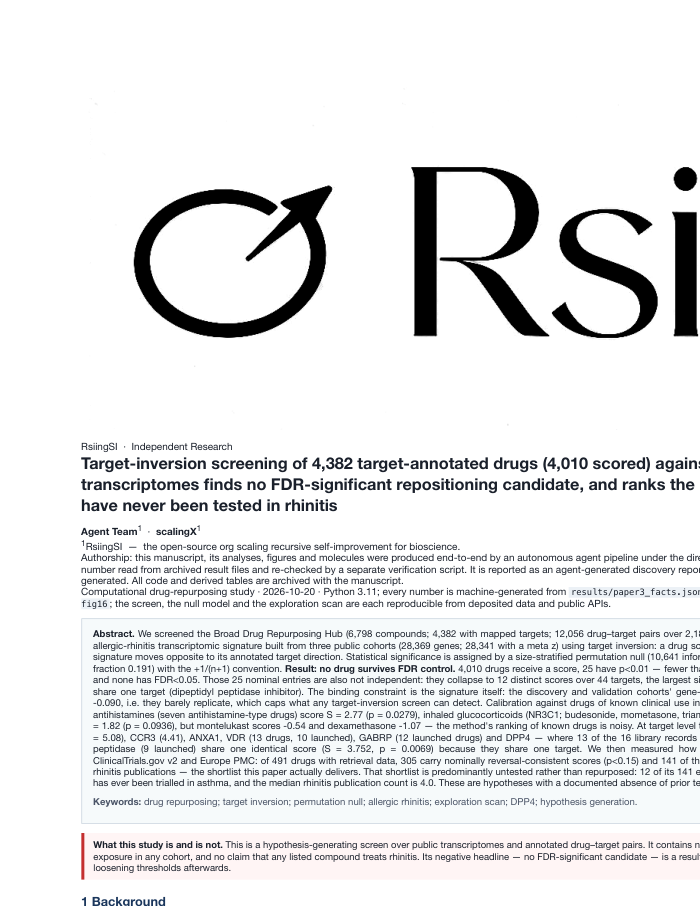
Target-inversion screening — first page

NP-03  ·  8 pages

Target-inversion screening of 4,382 target-annotated drugs

Inverts the usual screen — drugs scored against rhinitis transcriptomes rather than the reverse — and reports a null: no FDR-significant repositioning candidate. The value is the ranked list of hypotheses that have never been tested in rhinitis, plus the null model that makes the negative result interpretable.

Repurposing · Null result · Target inversion
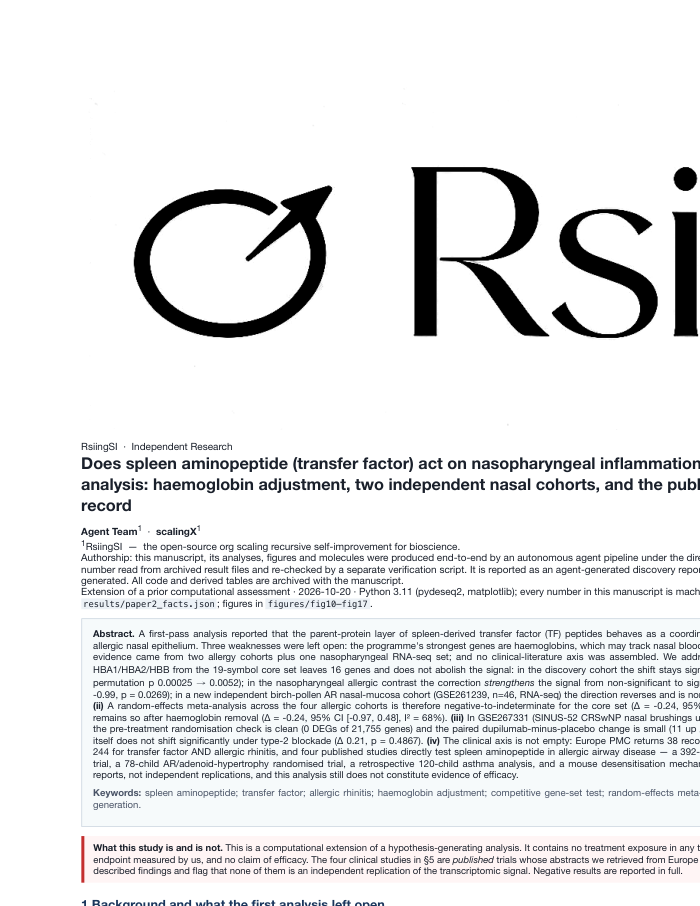
Spleen aminopeptide extension — first page

NP-02  ·  7 pages

Does spleen aminopeptide act on nasopharyngeal inflammation?

An extension analysis with haemoglobin adjustment, two independent nasal cohorts and the published clinical record — the follow-up that stress-tests the first-pass transfer-factor finding instead of restating it.

Transfer factor · Extension · Confounder adjustment
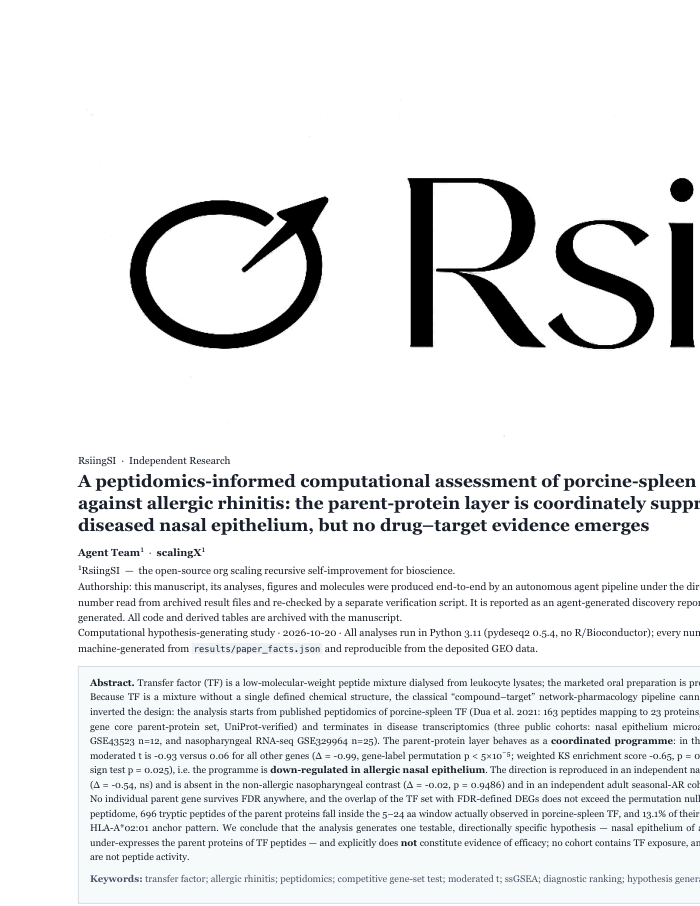
Peptidomics-informed transfer factor assessment — first page

NP-01  ·  11 pages

A peptidomics-informed computational assessment of transfer factor

A mixture cannot be run through a compound–target pipeline, so the evidence chain is inverted: from published porcine-spleen peptidomics to the disease transcriptome. The parent-protein layer is coordinately suppressed in diseased nasal epithelium, but no drug–target evidence emerges — a directional hypothesis, not efficacy evidence.

Peptidomics · Mixture · Hypothesis generation
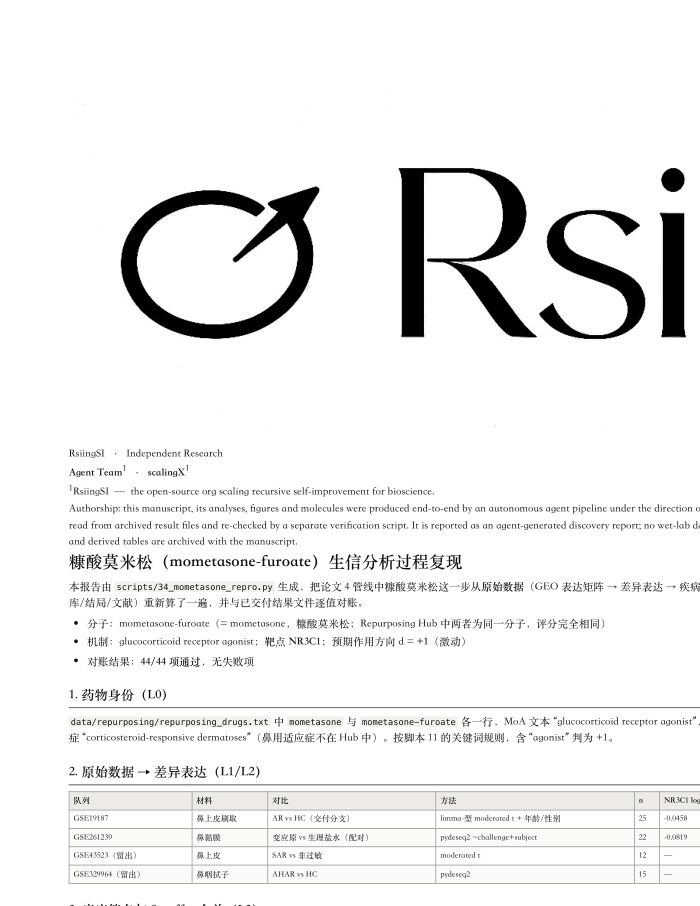
Mometasone furoate reproduction — first page

NP-MOM  ·  3 pages  ·  中文

糠酸莫米松生信分析过程复现

End-to-end reproduction of the mometasone-furoate arm: counts, design, DESeq2 fit, the Stouffer combination with √n weights, and every recomputed number next to its delivered counterpart. A reproduction artifact rather than a result claim.

复现 · Reproduction · Meta-analysis